From Zero to Launch: Building Oh! Divine Fashion's Complete Digital Growth System

THE BRIEF
Oh! Divine Fashion had 1,900-plus SKUs, curated clothing, stilettos, block heels, platform heels, and handbags, sitting in storage since 2020, generating carrying cost with no revenue mechanism attached to it. The client had inventory, and nothing else: no brand identity, no digital presence, no e-commerce infrastructure, no social media audience, no traffic system, and no conversion path.
The six foundational gaps were not independent problems. They were a sequence. You cannot convert traffic without a website. You cannot run paid ads without a brand identity. You cannot build an email list without a lead magnet. You cannot generate word of mouth without customers. Every gap depended on the one before it, which meant the only viable strategy was a precise sequencing plan, not a parallel build.
The brief was clear: launch this brand, in 90 days, with R35,000 ($2,112). From the onset I knew that a successful brand launch with a constrained budget required a strict and meticulous sequencing strategy before even thinking of writing on word of copy or designing wireframes.
THE PROBLEM - 6 FOUNDATIONAL GAPS
To understand the nuance of this project, the problem is broken down into six foundational gaps that every strong brand has close.


THE STRATEGY
Sequencing is strategy. Build what enables everything else first.
The single most important strategic decision in this project was not a channel choice, a budget allocation, or a creative direction. It was the build order. Infrastructure before traffic. Brand before ads. Trust signals before conversion CTAs. Every decision that followed, which platform to build on, which social channels to prioritise, how to allocate the budget across four phases, flowed from that sequencing logic.
I designed a four-phase campaign mapped to audience temperature:
Pre-Launch;
Brand Awareness;
Lead Generation; and
Warm/Hot Retargeting
Each phase was funded in proportion to its expected return at that stage of the funnel, not split evenly, which is the default and the wrong answer.
4 strategic decisions that formed the foundation of the campaign
Strategy In Action
OKR architecture, full-funnel budget design, and performance-marketing governance translated those decisions into an executable system.
Framework 1: OKR Architecture
The project was structured using OKRs (Objectives and Key Results) ,a goal-setting framework used by high-growth organisations to maintain strategic alignment between ambition and execution.
Each business objective was broken into three measurable key results with clear timelines, creating accountability at every stage. The OKRs were mapped against the full marketing funnel: Awareness → Interest → Consideration → Conversion → Retention. Every marketing activity was tied to a commercial outcome, not a vanity metric.
Business goals set at OKR stage:
Launch the e-commerce store by 01 September 2025
Establish brand awareness for Gauteng women (21–55)
Generate R100,000+ in sales in the first 3 months
Conversion Stage:
Objective: Convert engaged visitors into paying customers
KR1: Secure ≥45 paying customers in 3 months
KR2: Maintain average order value ≥ R700
KR3: Achieve ≥5% website conversion rate
Press the screenshot to view the full strategy.

Framework 2: Full-Funnel Marketing Strategy
The full-funnel strategy ensured no stage of the customer journey was left unaddressed. The campaign was divided into four execution phases, each mapped to a specific funnel stage with defined channels, budgets, KPIs, and timelines.
Total campaign budget: R35,000 across a 90-day window (September–December 2025)
Phase | Funnel Stage | Channels | Budget |
Pre-Launch | Infrastructure | Web, Social Setup | R500 |
Brand Awareness | Awareness | Instagram, Facebook, TikTok, Organic | R10,000 |
Lead Generation | Consideration | Meta & TikTok Ads, Email, WhatsApp | R12,000 |
Warm/Hot Targeting | Conversion & Retention | Meta Retargeting, Email Automations | R8,000 |
Press the screenshot to view the full strategy.

Framework 3: Performance Marketing Execution
With the strategy defined, execution was governed by a performance marketing framework. Every channel, content type, and campaign was assigned a specific conversion goal, a measurable KPI, and a budget allocation. No channel ran without a defined purpose in the funnel.
Two dedicated execution strategies were produced from this framework:
Social Media Marketing Strategy
Channel-specific content plans across Instagram, Facebook, TikTok, and WhatsApp Business. Each platform was assigned a distinct funnel role, not identical content replicated across channels. Instagram owned visual discovery. Facebook owned community and retargeting. TikTok owned cold reach and product discovery. WhatsApp owned lead nurture and conversion.
Press the screenshot to view the full strategy.

Email Marketing Strategy
A seven-sequence automation system covering the full customer lifecycle ,from first opt-in through to repeat purchase and loyalty. Each sequence was built with specific triggers, performance benchmarks, and revenue targets.
Press the screenshot to view the full strategy.

EXECUTION
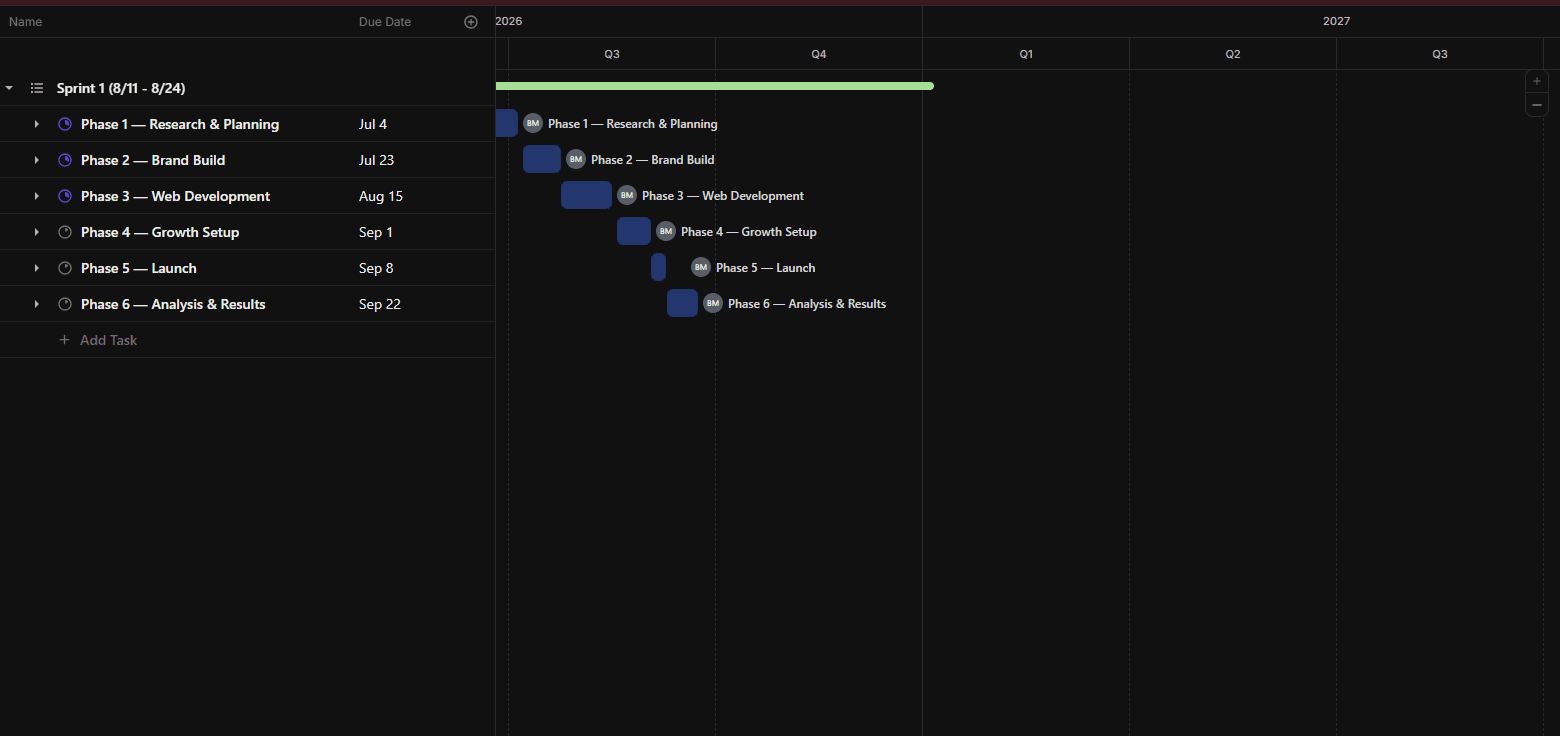
Six workstreams ran in parallel across the 90-day timeline. Each had a defined deliverable set, a completion milestone, and a client review at handoff. Project management ran in ClickUp with full task visibility and milestone tracking.
What follows is a documented account of what was built, how, and why each decision was made.


Brand Identity & Positioning
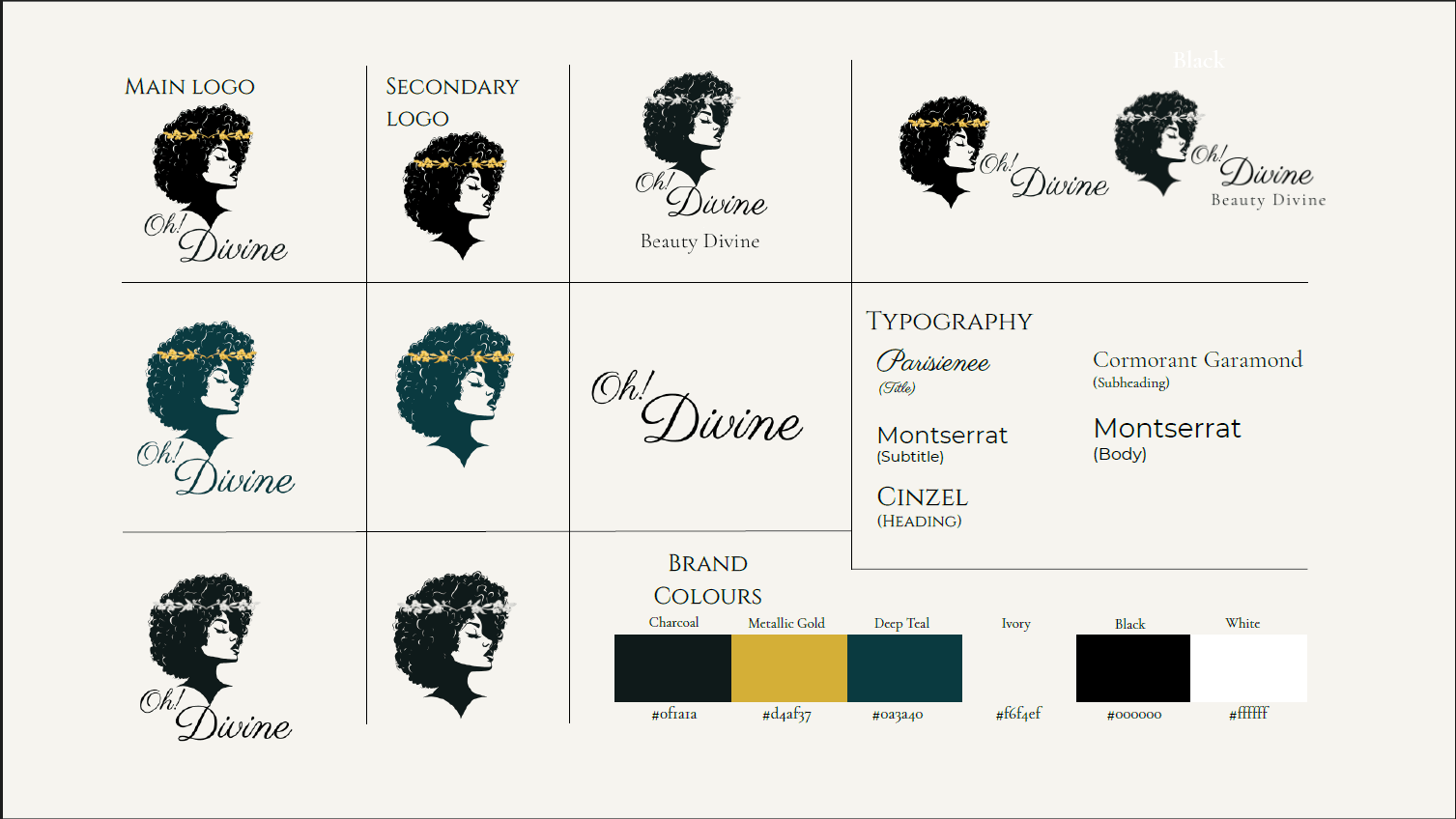
I built the brand identity from zero: brand name rationale, visual system (colour palette, typography, logo marks), brand voice guidelines, and a messaging framework for each of three product categories, footwear, clothing, and handbags. The positioning anchored on accessible luxury for South African women aged 21–55, with particular attention to the Gauteng market where cultural identity and fashion-forward sensibility intersect in ways that neither premium nor fast-fashion brands serve well.



E-Commerce Build & CRO
With a brand identity in place, the second gap to close was sales infrastructure. A brand with nowhere to transact is still a brand with R0 in revenue.
The store had to handle over 1,900 SKUs across three product categories, process live payments, function on mobile, and be built and tested within 30 days. Conversion architecture was baked in from the wireframe stage, not added after build.
Technical decisions made:
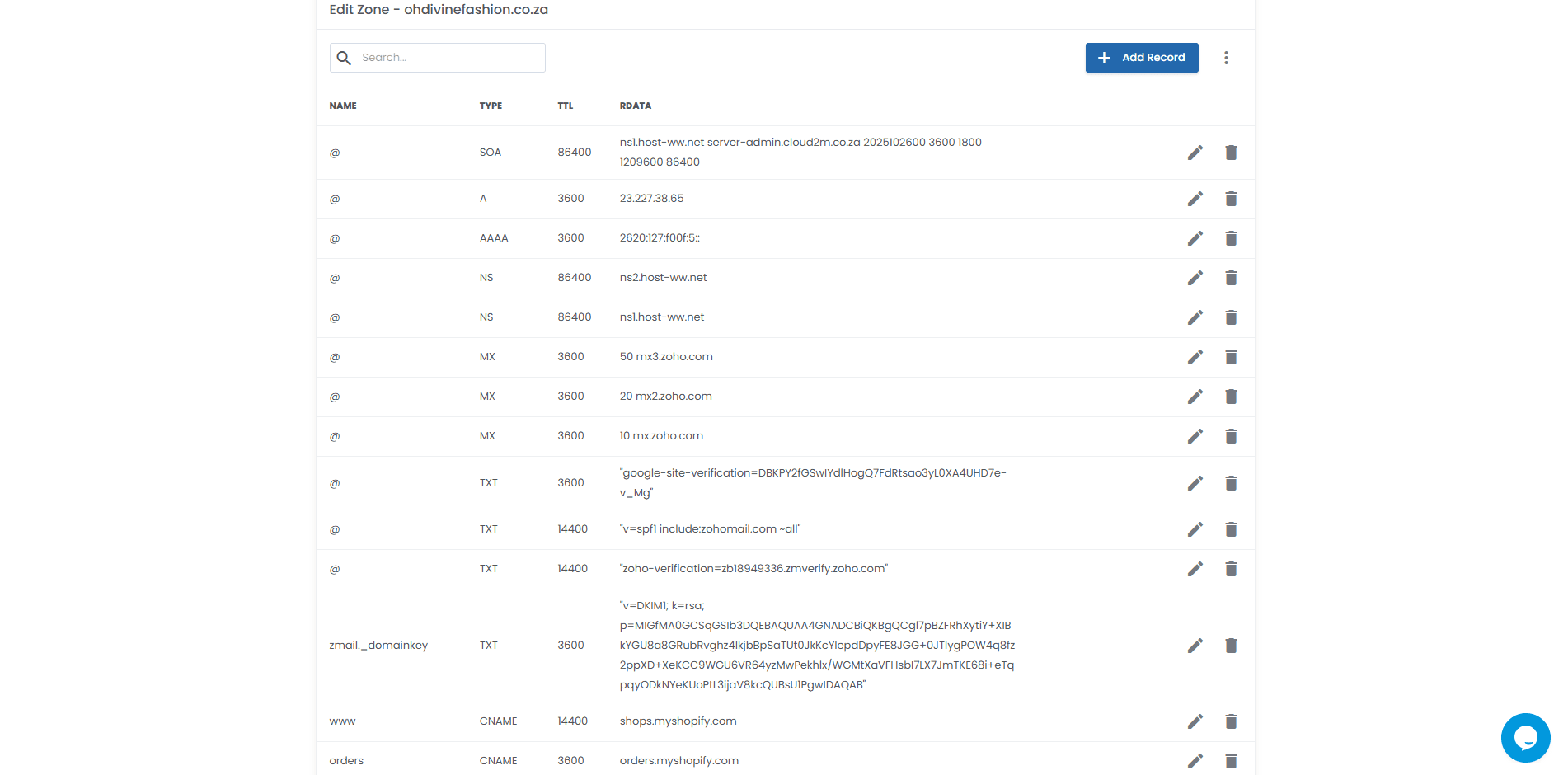
Shopify selected for catalogue depth and payment flexibility in the South African market
UI/UX wireframes completed before any build commenced
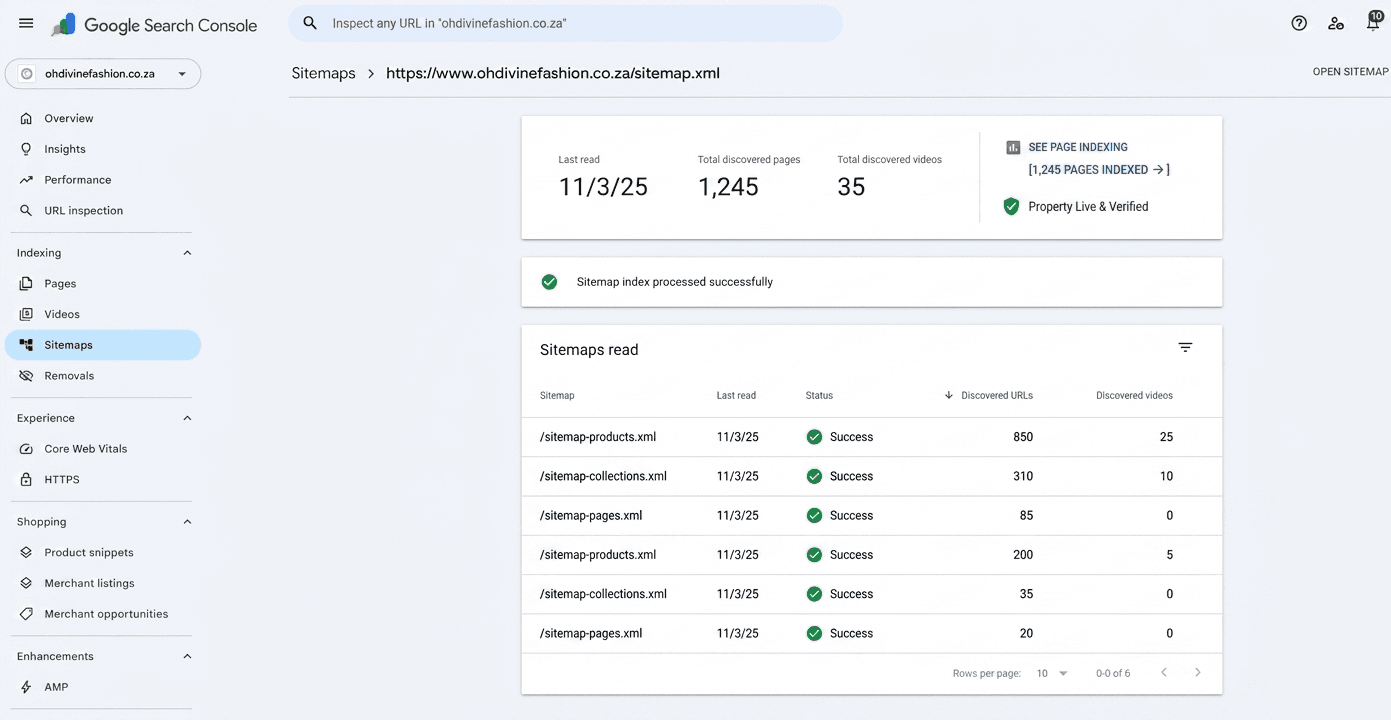
GA4 and Google Search Console integrated at launch for immediate data capture
Meta Pixel installed for retargeting capability from day one
POPIA compliance implemented: cookie consent, privacy policy, secure data handling
Web launch pre-build:
Page load speed: <3 seconds desktop and mobile
Mobile responsiveness: 100% pass across 5 screen sizes
Cross-browser compatibility: functional in ≥95% of tested browsers
SSL, secure forms, 99.9% uptime in first 72 hours
Checkout completion target: 99% payment success rate


![Shopify settings dashboard for Oh Divine Fashion showing the Domains page where ohdivinefashion.co.za is successfully connected and verified as the primary domain, with ohdivinefashion.myshopify.com set to redirect to it[cite: 14].](https://framerusercontent.com/images/DHrorshcmPJuAeYZZefZQKfL90.png?width=1382&height=752)

Complete Website Build & Copy
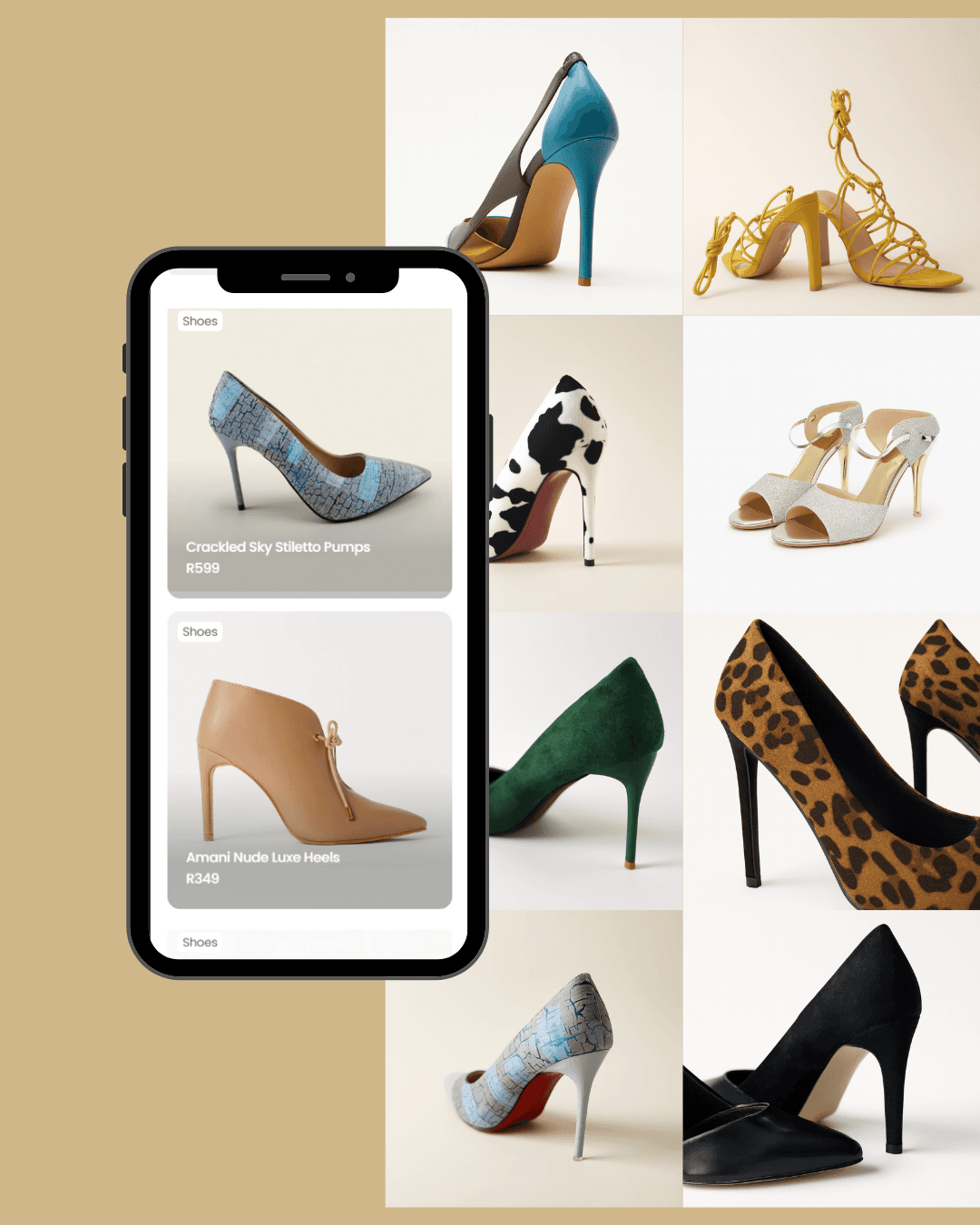
Press the graphics to view the full website copywriting.



Social Media Infrastructure
The store could now process a sale. The next problem was that nobody knew it existed. Closing the audience and traffic gaps meant building the channels before filling them with content.
Social media was treated as an infrastructure problem before it was treated as a content problem. Before any content was created, every platform had to be correctly structured, consistently branded, and strategically positioned.
Platform setup delivered:
Instagram, Facebook, TikTok, and WhatsApp Business accounts created and fully optimised
Consistent profile identity across all channels: handle (@ohdivinefashion), bio copy, category tags, CTAs, and cover assets
Story Highlight covers (Instagram)
WhatsApp Business profile with auto-reply configured
Content strategy:
Pre-launch phase: countdown content, logo reveal, teaser reels, behind-the-scenes , all designed to build anticipation before the store existed
Awareness phase: styling reels, product posters, lifestyle content , Gauteng women in urban and township settings
Each channel assigned a distinct funnel role, not identical content
Press the screenshot & graphics to view the full social page strategy & Copy.


Paid Media Campaigns
Organic infrastructure builds slowly. With a 90-day window, paid media was the lever to accelerate awareness and conversion on a schedule the business could not wait out organically.
The R35,000 campaign budget was allocated across four phases with increasing funnel specificity. Cold budget built the audience. Warm budget captured leads. Hot budget converted revenue.
Campaign architecture:
Phase 1: Pre-Launch
Platform setup and profile establishment. No paid spend on awareness until brand identity was complete.
Phase 2: Brand Awareness (#BeDivine)
R12,000 allocated Cold audience targeting: women, 21–55, Gauteng, RSA. Channels: Instagram (cold), Facebook (cold), TikTok. Content: styling reels, product posters, lifestyle images. KPIs: reach ≥250,000, CPM ≤R50, engagement ≥3–4%, CTR ≥2%.
Phase 3: Lead Generation
Allocated from R21,000 Meta lead forms (Instagram + Facebook), website pop-up opt-ins. Incentive: 10% first purchase discount. Target: 500+ email subscribers, 500+ WhatsApp opt-ins, open rate ≥25–30%, conversion ≥4–6%.
Phase 4: Warm/Hot Retargeting
Allocated from R21,000 Audiences: site visitors, post engagers, cart abandoners, repeat buyers. Creative: discount posters, BOGO reels, urgency-driven messaging. KPIs: ROAS ≥3.5:1, CTR ≥2.5%, CAC ≤R180, conversions ≥120, cart recovery ≥15–25%.
Press the screenshot & graphics to view the full social copywriting.



Email Marketing System
Paid media brings someone to the store once. Email was the system designed to keep bringing them back , turning a single transaction into a relationship.
Email was not built as a newsletter channel. It was built as a revenue system. Each of the seven sequences was engineered with a specific conversion goal, a defined trigger, measurable benchmarks, and a revenue target.
The abandoned cart sequence was designed to run within 48 hours of abandonment , Reminder at 1 hour, Incentive (10% off, 24-hour window) at 24 hours, Urgency (low stock / last chance) at 47 hours.
Press the screenshot and graphics to view the full email copywriting and sequences.


SEO & Content Infrastructure
Every channel built so far required ongoing spend or ongoing content to keep performing. SEO was the one investment designed to compound without either.
SEO was treated as a long-term asset, not a launch requirement. The infrastructure was built correctly at launch so that organic traffic would compound over time without requiring additional spend.
Keyword strategy: Research covered eight dimensions , core SEO terms, SEM (paid search), SMM terms, content and GEO (Generative Engine Optimisation) keywords, competitor gap terms, local/Gauteng-specific terms, seasonal terms, and Google Ads negative keywords. GEO was included as a distinct layer, optimising for how AI-driven search tools surface and cite content, not just traditional search engine ranking.
Blog content calendar (Q4 2025):
Press the blog title for the full blog copy
Publish Date | Primary Keyword | Title ( |
15 Sept 2025 | statement heels Gauteng | |
22 Sept 2025 | sculptural heels | Walking on Art: Why Sculptural Heels Are the Must-Have Statement Piece of 2025 |
29 Sept 2025 | women's sneakers and dresses |
Press the screenshot to view the full keyword research.


RESULTS & IMPACT
The campaign launched on 01 September 2025. The following figures are actuals from the first 90 days, measured against the targets set at the strategy stage before a single rand was spent.
Impact:
Three numbers here matter more than the rest. The customer acquisition cost of R96 came in 47% below the R180 cap set at the OKR stage , meaning the funnel acquired customers at roughly half the cost the business could still afford to pay profitably. Return on ad spend reached 5.26x against a 3.5x target, 50% above the threshold originally set as the point where the campaign became self-funding within its 90-day window.
The 1.5% purchase conversion rate sits below the 5% target set at the OKR stage. Read in isolation, this looks like underperformance. Read against the CAC and ROAS figures, it tells a different story: traffic quality and ad targeting were strong enough that even a conservative conversion rate produced efficient, profitable acquisition. The gap between targeted and actual conversion rate is the clearest priority for the next 90-day cycle.
BUSINESS IMAPCT
At the start of this engagement, Oh! Divine Fashion did not exist in any commercially operational sense. By September 2025, it was a live, branded, converting e-commerce business with a functional growth stack.
Three things this engagement produced that the client did not have before:
A commercially viable business infrastructure
The client moved from physical inventory with no sales channel to a fully operational e-commerce business, with a tested store, active payment processing, and a live digital presence across four platforms.
A scalable growth system, not a campaign
Every component built during this engagement, the email sequences, the retargeting infrastructure, the SEO foundation, the social content framework, continues to generate compounding return after the initial launch period. The system runs without requiring the same level of input to maintain.
A positioned brand in a competitive market Oh! Divine did not launch as another online fashion store. It launched as a positioned brand, with a defined identity, a documented voice, and a clear cultural proposition that differentiates it in a saturated market.
PROJECT REFLECTIONS & LEARNINGS
Taking Ownership of the Entire Product Lifecycle
This was the first project where I took complete ownership of an entire product and digital marketing lifecycle, from brand strategy and product positioning to website development, content creation, campaign execution, and performance analysis.
The greatest challenge was developing the strategy itself. It required me to think beyond marketing and approach every decision from a business owner's perspective. I had to determine how customers would perceive the brand, create a consistent identity, photograph products professionally using only my iPhone, write persuasive copy, and translate all of those elements into a cohesive customer experience.
More importantly, I learnt that effective marketing is not a collection of isolated tactics. Every decision influences the next stage of the customer journey, and success comes from ensuring each component works together toward a common objective.
Using AI as a Strategic Tool
Throughout the project, it was tempting to rely on artificial intelligence to generate all the website copy or even build large portions of the website automatically. Instead, I intentionally used AI as an assistant rather than a replacement for critical thinking.
I used ClickUp Brain to stay organised across multiple projects, Shopify Sidekick and Shopify Magic to improve website functionality and content, and Claude, ChatGPT, and Gemini to brainstorm campaign ideas, refine copy, and generate realistic lifestyle imagery featuring human models to showcase products. I also leveraged WebFX's AI Score to evaluate and improve my AI Search and Generative Engine Optimisation (GEO) writing.
This project reinforced that AI delivers the greatest value when it enhances human judgement, creativity, and productivity rather than replacing them.
Traditional Tools Still Matter
While modern AI tools accelerated many aspects of the project, traditional productivity software remained indispensable. Microsoft Word and Excel provided structure for planning, documentation, and analysis, while Google Docs and Google Sheets enabled seamless collaboration with the client and other contributors.
The experience reminded me that successful project delivery depends on selecting the right tool for the right task rather than chasing the newest technology.
Sequencing Is Strategy
One of the most valuable lessons from this project was that execution sequence is itself a strategic decision.
The order matters:
Brand before store.
Store before traffic.
Traffic before conversion.
Skipping or reversing these stages creates downstream problems that become increasingly expensive and time-consuming to correct. Building a strong strategic foundation made every subsequent phase significantly more effective.
Budget Constraints Create Better Decisions
Managing a complete product launch on a budget of approximately R35,000 required disciplined prioritisation.
Every decision had to justify its cost, from technology choices and marketing channels to campaign timing and performance metrics. Rather than limiting creativity, the financial constraint forced sharper strategic thinking and prevented unnecessary complexity.
I learned that effective marketers optimise for impact, not expenditure.
South African Consumers Require South African Strategies
One of the clearest lessons was that successful digital marketing must reflect local consumer behaviour.
For example, positioning WhatsApp as a primary customer engagement and lead generation channel was a deliberate strategic decision informed by South African user behaviour, rather than following international best practices without question.
This reinforced an important principle: localisation is not simply translating content or changing currency, it requires adapting the entire customer journey to how people actually discover, evaluate, communicate, and purchase within a specific market.
Applying global digital marketing frameworks without local adaptation is one of the most common reasons campaigns underperform. Effective strategy always begins with understanding the customer in their own context.