


Prompt. Click. Abracadabra. Words appear.
Artificial Intelligence has disrupted the core of content creation.
Marketing copy can now be generated in seconds, often at a fraction of the cost of hiring a professional copywriter.
For marketers under constant deadline pressure, it feels like the perfect shortcut.
But there's a catch.
Copywriting sits at the heart of every marketing campaign. It shapes a brand's identity, communicates its value, and persuades customers to buy.
It isn't a box to tick; it's the manifestation of a brand's personality, values, and promise in the mind of its customer.
That's precisely why speed alone was never a good enough reason to remove the human from the process. Speed was never the hard part of marketing. Persuasion was and still is.
The global AI content marketing industry is now worth close to $58 billion, and 94% of marketers plan to work AI into some part of their content process this year. The AI writing tools segment alone is valued at $2.5 billion, projected to reach $12.1 billion by 2033.
The question is no longer whether businesses will adopt AI. They already are.
The real question is whether AI-generated copy increases or decreases conversion, trust, and revenue, and that experiment is still playing out in public, across real ad accounts, with real budgets.
The obvious conclusion: AI can now do a copywriter's job
That assumption has been driving marketing budget decisions since AI copywriting tools went mainstream. The evidence tells a more complicated story.
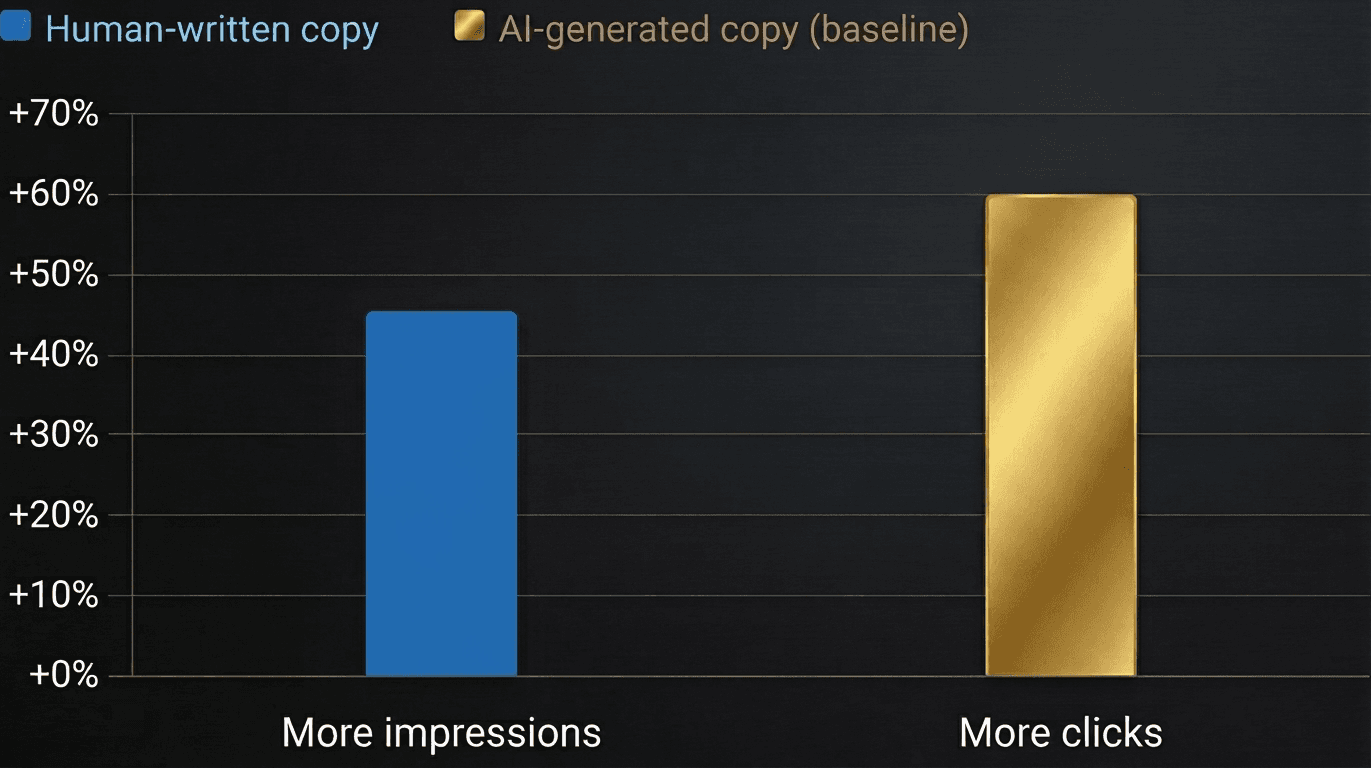
In a controlled Google Ads experiment run by Search Engine Journal, human-written ad copy generated 45.41% more impressions and 60% more clicks than AI-generated copy, running in the same account, targeting the same audience, on the same budget.
The product didn't change.
The audience didn't change.
The spend didn't change.
The only variable was who wrote the words.
Speed and persuasion are not the same skill. AI has only solved for one of them.
That gap extends well beyond paid ads.
Unbounce trained a machine-learning model on nearly 37,000 landing pages and found copy was more than twice as influential on conversion as design, accounting for 28% of performance versus 13% for design elements.
Yet most marketing teams still over-invest in visuals and under-invest in the words that actually persuade.
The imbalance only widens with generative AI in the mix: copy can now be produced in bulk within seconds, while design still passes through rounds of human review.
What copywriting is actually doing in your funnel
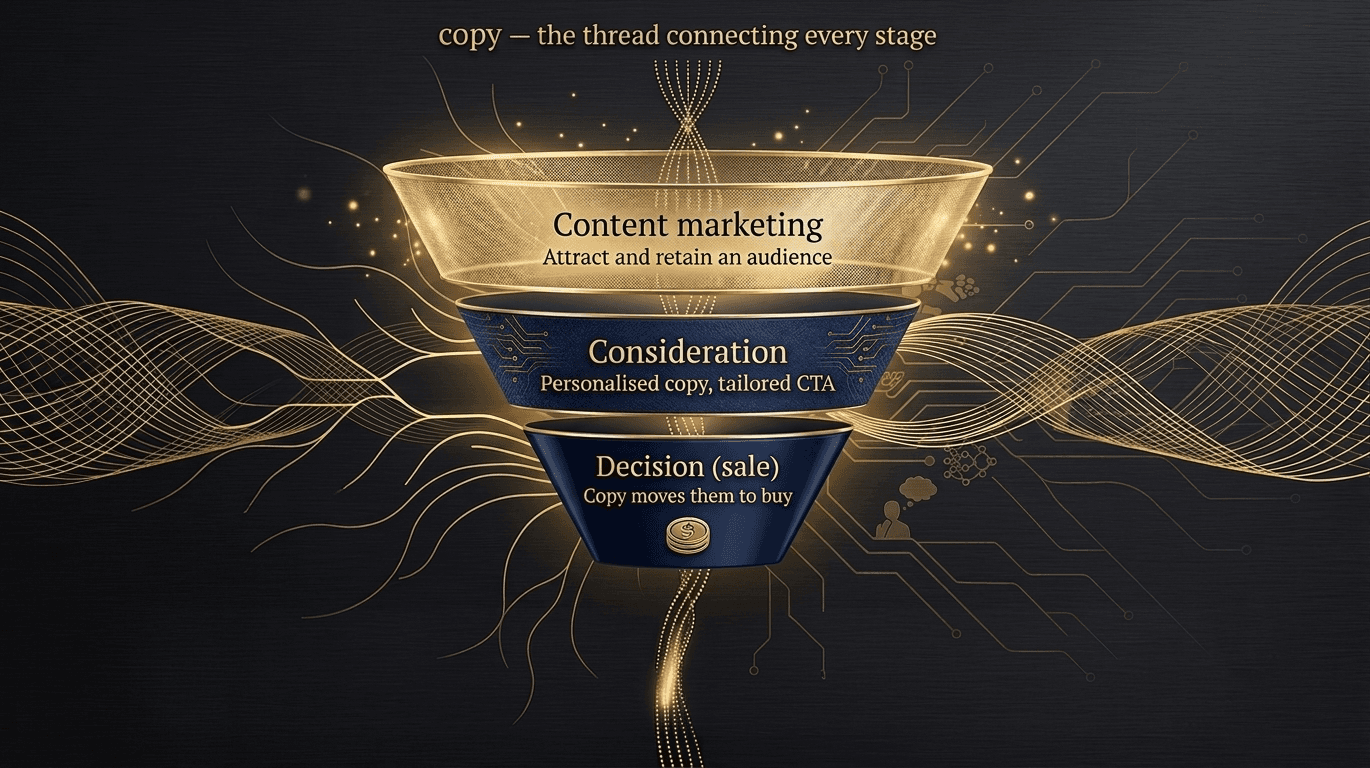
Content marketing and sales are often treated as separate disciplines. In practice, copy is the thread connecting them.
On the content side, the Content Marketing Institute defines content marketing as building and retaining an audience through valuable, relevant, consistent content.
Your copy is what decides whether that content earns attention or gets scrolled past.
On the sales side, Pipedrive defines selling as moving a prospective customer through a structured journey toward a decision.
Copy is the mechanism that does the moving. Without it, a funnel is just a sequence of empty rooms. This is why personalisation has earned its reputation as one of the highest-leverage moves in copywriting.
HubSpot analysed more than 330,000 calls-to-action over six months and found personalised CTAs converted 202% better than generic ones. That’s not a marginal lift, but more than double.
A single line of copy, written for a specific segment instead of everyone at once, outperformed the generic version two to one.
Effective copywriting was never about producing more, faster.
It's about getting the right message to the right person, at the right moment.
Ultimately, the closer your copy matches the reader's context and intent, the more likely it moves them from consideration to action. But AI-generated copy cannot achieve that on its own.
What this means for how you actually use AI
This isn't an argument against AI in the copywriting process. It's an argument against removing the human from it.
Businesses seeing real results aren't choosing between AI and human copywriters; they're using both.
AI handles volume, first drafts, and rapid variation testing. While humans provide strategy, brand stewardship, and the emotional judgement the evidence above shows AI still struggles to replicate.
AI performs best when it's fed proprietary material to work from. This includes customer research, brand guidelines, positioning, sales conversations, and past campaign data. It performs far worse on a generic prompt like "write ad copy for a fashion brand."
The principle here is simple: ‘Generic input produces generic output.’

Writing for humans and AI discovery at once
There's a second shift happening alongside the first:
AI hasn't just changed how copy gets written; it's changed how it gets found.
Traditional search is increasingly being supplemented, and in some cases bypassed, by AI-driven discovery.
Buyers now research products through AI assistants before they ever land on a company's website. In that environment, the copy that wins isn't the most keyword-stuffed. It's copy that's clear, well-structured, authoritative, and useful enough for an AI system to surface and cite.
This is where copywriting, SEO, and Generative Engine Optimisation (GEO) start to converge.
The same traits that build trust with a human reader, clarity, specificity, evidence, expertise, are what make content more likely to be referenced by an AI system.
The goal is no longer just to rank on a results page. It's to become the source AI trusts enough to quote.

Check this before your next campaign goes live
Four questions worth asking honestly:
Did a human review and refine the last piece of AI-generated copy you shipped, or did it go live exactly as the model produced it?
Is your CTA personalised by audience segment, or is every visitor seeing the same generic line?
Are you investing more in your landing page's words, or mostly in its design?
If you handed AI a prompt today, would it draw on your real brand voice and customer language, or default to generic marketing jargon?
If you answered "no" to more than one, you've likely found the source of your conversion problem. The issue was never AI. It's AI operating without oversight.
The bottom line
AI can generate words at a speed no copywriter can match.
What it can't do is understand your customer, your positioning, or the emotional trigger that actually moves someone to buy. Those responsibilities still belong to the marketer.
The competitive advantage isn't using AI to replace copywriters. It's using AI to accelerate production while a human stays responsible for strategy, judgement, and persuasion.
Because in marketing, the fastest copy is rarely the one that converts, and the brands that understand this now will be the ones still standing out once everyone else's content starts sounding the same.
If it's not already happening.
If your copy is doing the AI's job, fast, generic, forgettable.
Then it's time for a rebuild.
Whether that's a single high-stakes landing page or a full audit of your funnel copy, get in touch and let's fix what's costing you conversions.
References
Arvow. (2026). AI Content Marketing Statistics (2026): 50+ Data Points on Adoption, ROI, and Trends.
Content Marketing Institute. (2023). What Is Content Marketing?
HubSpot. (2025). Personalized Calls-to-Action Convert Better [New Data].
Search Engine Journal / Hop Skip Media. (2024). Humans Vs. Generative AI: A Head-To-Head Ad Copy Content Test.
Unbounce. (2025). Copy or Design: What's More Important to Your Landing Page Success?
Pipdrive. (2026). What is sales? Everything you need to know in 2026.


